
Why Standard MCT Oil Is Not Enough for Muscle Recovery
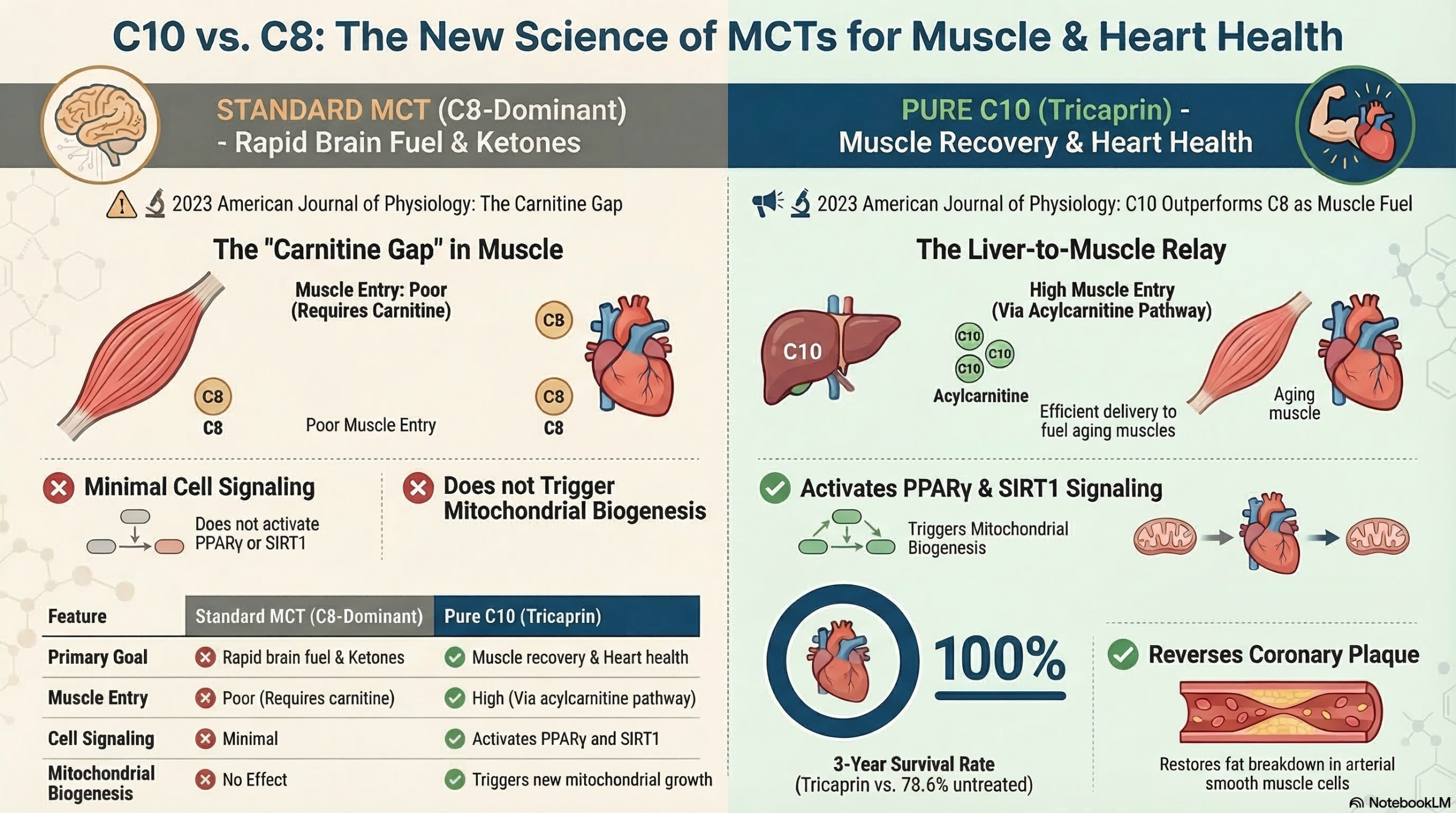
Most MCT oil is 60–80% C8. But a landmark 2023 study found that C8 cannot enter skeletal muscle mitochondria without carnitine — the very carrier molecule that aging depletes. The gap between MCT oil marketing and muscle science is wider than anyone is telling you.
Walk into any health food store and you'll find shelves of MCT oil products promising faster recovery, better energy, and preserved muscle mass. Most of them are telling a partial truth. The active ingredient the label is implicitly pointing to — the one with the actual muscle research behind it — is not what's in the bottle in the concentration that matters.
The MCT oil industry has grown on the back of research that is largely applicable to C8 (caprylic acid) or C10 (capric acid) individually. But most commercial MCT oil products are 60 to 80 percent C8, with C10 playing a supporting role at best. And a critical 2023 study published in the American Journal of Physiology revealed something that fundamentally changes the calculus for anyone using MCT oil specifically for muscle health:
Pereyra et al. (2023) demonstrated that heart and skeletal muscle cannot oxidize medium-chain fatty acids of any chain length without carnitine — including C8. The carnitine-independent bypass that MCT oil is marketed on applies only to liver metabolism. For the tissue that matters most in sarcopenia — skeletal muscle — C8 is not a bypass at all. C10, however, benefits from the critical downstream effects of liver-generated metabolites and its unique PPARγ-mediated, acylcarnitine-supported pathway in muscle.
This article unpacks what that finding means, why it doesn't invalidate C10-based Tricaprin, and what the broader science — including a remarkable human case series published in the European Heart Journal — tells us about why the specific molecule matters enormously for muscle and vascular tissue.
What "MCT Oil" Actually Contains — and What the Label Isn't Telling You
The letters MCT stand for Medium-Chain Triglyceride — a fat molecule built from fatty acid chains of 6 to 12 carbons. The MCT family includes four main members: C6 (caproic), C8 (caprylic), C10 (capric), and C12 (lauric) acid. They are absorbed differently, metabolized differently, and produce different biological effects.
When you buy a product simply labeled "MCT oil," you are almost certainly buying a blend — and the composition of that blend matters enormously. Industry-standard MCT oil is typically fractionated coconut oil, from which the most economically efficient fatty acids have been extracted. The result is a product weighted heavily toward C8, the fastest-converting ketone precursor, because that is what ketogenic dieters historically demanded.
The fundamental problem is not that C8 is a bad ingredient. For rapid ketone production and brain fuel, C8 is outstanding. But for skeletal muscle recovery and preservation — which require fuel to reach and be burned inside the mitochondria of muscle cells — C8 has a critical limitation that the marketing has glossed over completely.
- ✅ Fastest ketone production — excellent brain fuel
- ✅ Liver processes C8 efficiently without carnitine
- ✅ Good for short-burst cognitive energy
- ✅ Well-studied for ketogenic diet support
- ❌ C8 cannot enter skeletal muscle mitochondria without carnitine (AJP, 2023)
- ❌ No PPARγ activation — no mitochondrial biogenesis signal
- ❌ No GPR84/GLP-1 stimulation for glucose metabolism
- ❌ No smooth muscle cell TG lipolysis (no TGCV-relevant mechanism)
- ✅ Liver generates acylcarnitine-C10 — deliverable to muscle
- ✅ PPARγ agonist → mitochondrial biogenesis in muscle cells
- ✅ GPR84 → GLP-1 → blood sugar stabilization
- ✅ Corrects intracellular TG accumulation in smooth muscle cells
- ✅ SIRT1 activation — longevity enzyme signaling
- ✅ Complex I + IV respiratory chain upregulation
The 2023 Study That Rewrote the MCT-Muscle Story
For decades, the conventional wisdom about MCT oil and muscle energy rested on a foundational assumption: medium-chain fatty acids bypass the carnitine shuttle and enter mitochondria directly in all tissues. This made MCTs seem universally superior to long-chain fats for cellular energy delivery. The only problem is that assumption was based almost entirely on liver metabolism studies — and researchers never systematically tested whether it held true in heart and skeletal muscle.
Pereyra et al. (2023), publishing in the American Journal of Physiology — Gastrointestinal and Liver Physiology, set out to answer this question rigorously. They measured the oxidative metabolism of free fatty acids from 6 to 18 carbons in four tissues: liver, kidney, heart, and skeletal muscle.
What They Found — Tissue by Tissue
| Tissue | Can Oxidize C8 Without Carnitine? | Can Oxidize C10 Without Carnitine? | Implication |
|---|---|---|---|
| Liver | ✓ Yes | ✓ Yes | C8 & C10 bypass works here — MCT oil marketing applies to liver |
| Kidney | ✓ Yes | ✓ Yes | C6–C10 oxidized without carnitine; C8 is not the dominant substrate |
| Heart Muscle | ✗ No | ✗ No | All chain lengths require carnitine; but C10–C18 acylcarnitines support HIGH respiration |
| Skeletal Muscle | ✗ No | ✗ No | All chain lengths require carnitine; C6–C8 acylcarnitines are POOR substrates here |
The headline finding: heart and skeletal muscle cannot oxidize any free fatty acid — including C8 and C10 — without carnitine. The carnitine-independent bypass is exclusively a liver and kidney phenomenon. This finding, as the researchers themselves noted, calls for a fundamental re-evaluation of the claims made about MCT oil and muscle performance.
Here is where C10 retains a significant advantage despite also requiring carnitine in skeletal muscle: the study found that acylcarnitines of longer chain lengths (C10 to C18) support the highest mitochondrial respiration rates in heart and skeletal muscle — while shorter acylcarnitines (C6 to C8) are oxidized at significantly lower rates. This means that once C10 is packaged into acylcarnitine form by the liver and delivered to muscle, it is a superior substrate for mitochondrial energy production compared to C8. C8-derived acylcarnitines are poor performers in the very tissue that matters most for muscle recovery.
Additionally, C10's unique upstream effects — PPARγ activation, mitochondrial biogenesis, SIRT1 signaling, and GPR84-mediated GLP-1 release — are independent of whether C10 itself physically crosses the mitochondrial membrane. These systemic effects reshape the cellular environment of muscle tissue in ways that C8 simply does not.
From Skeletal Muscle to Smooth Muscle: The Coronary Connection
The 2023 AJP finding about skeletal muscle is striking. But it becomes even more significant when you connect it to a parallel story playing out in a different type of muscle tissue: the smooth muscle cells that line the walls of your coronary arteries.
This is where the European Heart Journal (2023) case series by Hirano, Higashi, and Nakajima enters the picture — and where the implications for understanding C10's unique role in muscle tissue become visceral and undeniable.
Remarkable Regression of Diffuse Coronary Atherosclerosis
In two patients in their 60s with treatment-resistant angina and diabetes — diagnosed with Triglyceride Deposit Cardiomyovasculopathy (TGCV) — dietary Tricaprin intake led to marked regression of atherosclerotic coronary lesions with measurable luminal dilatation, confirmed by coronary CT angiography. Critically, standard serum lipid levels and HbA1c were unchanged. The regression occurred not because of cholesterol reduction, but because of restored intracellular triglyceride lipolysis in smooth muscle cells.
As lead researcher Dr. Ken-ichi Hirano stated: this is the first documented regression of coronary atherosclerosis due to increased cellular TG breakdown — a conceptually novel treatment mechanism that bypasses the entire statin/cholesterol pathway.
Read the full paper → European Heart Journal, 2023 (DOI: 10.1093/eurheartj/ehac762)Why Smooth Muscle Cells Matter for This Conversation
TGCV affects a specific type of muscle cell that most people never think about: the vascular smooth muscle cells (VSMCs) embedded in coronary artery walls. In TGCV patients, these cells cannot break down the long-chain triglycerides stored inside them — not because the arteries are clogged with cholesterol (standard atherosclerosis), but because the fat inside the cells themselves refuses to be cleared. The result is cellular steatosis — the same energy-failure-from-fat-accumulation dynamic seen in skeletal muscle sarcopenia, just in a different tissue.
Tricaprin corrects this by delivering C10 into these cells, where it restores the lipolytic process that clears the stored TG backlog. The medium-chain triglyceride essentially acts as a metabolic wedge — enabling cells to process fat they have been unable to break down, restoring energy production and cellular function simultaneously.
Whether the affected tissue is a skeletal muscle cell starved of fuel due to mitochondrial aging, or a smooth muscle cell in a coronary artery wall overloaded with undigested triglycerides — the underlying problem is the same: defective intracellular fat metabolism leading to energy failure and cellular dysfunction. Standard MCT oil (C8-dominant) addresses neither. Tricaprin (pure C10) has demonstrated mechanistic relevance in both contexts.
The Research Foundation
The Tissue-Specific Carnitine Finding — AJP 2023
Pereyra AS et al. (East Carolina University) systematically demonstrated that cardiac and skeletal muscle cannot oxidize free MCFAs of any chain length without carnitine — overturning the assumption that MCT oil provides a universal bypass. Critically, C10–C18 acylcarnitines (the carnitine-packaged form) drove the highest respiration rates in muscle, while C6–C8 acylcarnitines were poor substrates. This repositions C10 as superior to C8 specifically for muscle mitochondrial fuel delivery.
Read the Study → American Journal of Physiology, 2023Coronary Atherosclerosis Regression via Smooth Muscle TG Lipolysis
Hirano K, Higashi M, Nakajima K (Osaka University, 2023) documented the first case of coronary atherosclerosis regression driven by restored intracellular lipolysis — not cholesterol lowering — in smooth muscle cells of TGCV patients. Tricaprin dietary supplementation produced marked regression of coronary lesions with luminal dilatation on CT angiography within months, without any change in serum lipids.
Read the Study → European Heart Journal, 2023C10 Drives Mitochondrial Biogenesis via PPARγ — Not C8
Hughes et al. (Journal of Neurochemistry, 2014) confirmed that C10 — specifically, not C8 — activates PPARγ to trigger mitochondrial biogenesis, increase citrate synthase activity, and upregulate Complex I in cells. This upstream signaling cascade creates new mitochondria and improves the efficiency of existing ones — a benefit that applies across muscle tissue types regardless of the carnitine picture.
Read the Study → Journal of Neurochemistry, 2014Human Muscle Outcomes: 6g/day C8+C10 MCTs in Frail Older Adults
Ezaki & Abe (Frontiers in Nutrition, 2023) combined data from 3 clinical trials showing that 6g/day of C8/C10 MCTs over 3 months significantly improved grip strength, walking speed, and muscle mass in frail adults (mean age 85). These real-world outcomes reflect the integrated effect of C10's mitochondrial and metabolic mechanisms — not C8's ketone production, which does not produce these muscle-specific benefits independently.
Read the Study → Frontiers in Nutrition, 2023Long-Term Survival Recovery in TGCV — Nature 2025
The Hirano et al. 2025 registry study in Nature Cardiovascular Research extended the TGCV story from case series to population-level outcome data: 100% 3-year and 5-year survival in Tricaprin-treated patients vs. 78.6% and 68.1% in untreated controls. The mechanism — corrected intracellular fat metabolism in cardiomyocytes and smooth muscle cells — confirms that Tricaprin's effect on muscle tissue energy is not an isolated curiosity but a reproducible, clinically significant intervention.
Read the Study → Nature Cardiovascular Research, 2025What This Means When You're Standing in the Supplement Aisle
The practical takeaway from this body of research is not that MCT oil is useless — it is that choosing the right molecule for the right goal matters enormously, and the supplement industry has been conflating C8 and C10 for years under the convenient umbrella of "MCT."
If you are a healthy adult using MCT oil primarily as a ketogenic diet aid or a brain-fuel additive to morning coffee, C8-dominant MCT oil is a rational choice. The liver processes it rapidly, the ketone production is robust, and the cognitive benefit is real.
But if you are an adult over 50 using MCT oil specifically because you want to:
→ Preserve and rebuild muscle mass — C10's acylcarnitine form is the superior mitochondrial substrate in skeletal muscle (AJP 2023); C8-acylcarnitines are poor performers there.
→ Trigger mitochondrial biogenesis — C10 activates PPARγ in muscle cells; C8 does not share this property.
→ Stabilize blood sugar and reduce energy crashes — C10 stimulates GLP-1 via GPR84; C8 does not activate this receptor at meaningful levels.
→ Support vascular and cardiac health alongside muscle health — C10 has demonstrated intracellular lipolysis correction in smooth muscle cells; no equivalent data exists for C8.
The muscle recovery case for C10 is not built on C8's ketone story repurposed for a different tissue. It is built on a distinct set of mechanisms that C10 — and only C10 — has been shown to possess.
The AJP 2023 tissue specificity finding was conducted in animal tissue homogenates, not human subjects. The TGCV cardiovascular data applies to a specific rare cardiac condition. The PPARγ and mitochondrial biogenesis research is primarily cell-line based. While the mechanisms are well-characterized and mechanistically compelling across multiple independent research groups, large-scale human clinical trials specifically measuring C10's effects on skeletal muscle recovery independent of C8 are still needed. We present this research accurately and encourage readers to consult their healthcare provider before making changes.
Practical Guide: Choosing the Right MCT for Muscle Recovery
Read the Label — Demand a Fatty Acid Breakdown
Any MCT oil worth using for muscle health should list the exact percentage of C8 (caprylic acid) and C10 (capric acid) on the label. If a product simply says "MCT oil" or "fractionated coconut oil" without a fatty acid profile, assume it is predominantly C8. Look for products with at least 40–50% C10, or ideally pure C10 (Glyceryl Tricaprate / Tricaprin).
Time C10 Around Meals, Not Just Exercise
Unlike C8 (which is best taken pre-workout for ketone fuel), C10's most important mechanisms — PPARγ activation, GLP-1 secretion, mitochondrial biogenesis — are ongoing cellular processes, not acute performance boosts. Taking C10 with your first meal of the day consistently over weeks is more likely to produce structural mitochondrial improvements than high-dose pre-workout use.
Support Carnitine Levels to Maximize C10 Delivery to Muscle
Given the AJP 2023 finding that skeletal muscle requires carnitine for MCFA oxidation, supporting adequate carnitine levels makes sense. Dietary carnitine is found in red meat (especially lamb and beef), dairy, and poultry. If you follow a plant-forward diet, discuss supplemental L-carnitine (500–1000mg/day) with your doctor — it may enhance C10's delivery to muscle mitochondria.
Pair With Resistance Exercise for Maximum Muscle Effect
C10 triggers mitochondrial biogenesis via PPARγ. Resistance exercise triggers it via a parallel pathway (AMPK). These are additive signals. Even light resistance training 2–3 times per week — bodyweight squats, resistance bands, or light weights — amplifies the mitochondrial construction program that C10 initiates, accelerating the muscle recovery benefits.
Commit to 90 Days — Mitochondrial Changes Are Structural, Not Acute
The human muscle trial (Ezaki & Abe, 2023) ran for 3 months and showed significant improvements in grip strength and walking speed. Mitochondrial biogenesis and smooth muscle metabolic correction are structural changes that accumulate over weeks, not sessions. Track your recovery time after exertion, your mid-afternoon energy levels, and your functional strength — not just how you feel after a single dose.
-
1
Tissue-Specific Carnitine Requirement for MCFA Oxidation — Pereyra AS, McLaughlin KL, Buddo KA, Ellis JM. "Medium-chain fatty acid oxidation is independent of l-carnitine in liver and kidney but not in heart and skeletal muscle." American Journal of Physiology — Gastrointestinal and Liver Physiology. 2023;325(4):G287–G294.
DOI: https://doi.org/10.1152/ajpgi.00105.2023 -
2
Coronary Atherosclerosis Regression via Smooth Muscle TG Lipolysis — Hirano K, Higashi M, Nakajima K. "Remarkable regression of diffuse coronary atherosclerosis in patients with triglyceride deposit cardiomyovasculopathy." European Heart Journal. 2023;44(13):1191.
DOI: https://doi.org/10.1093/eurheartj/ehac762 -
3
C10 PPARγ Activation & Mitochondrial Biogenesis — Hughes SD, Kanabus M, Anderson G, et al. "The ketogenic diet component decanoic acid increases mitochondrial citrate synthase and complex I activity in neuronal cells." Journal of Neurochemistry. 2014;129(3):426–433.
DOI: https://doi.org/10.1111/jnc.12646 -
4
Human MCT Muscle Trial — Ezaki O, Abe S. "Medium-chain triglycerides (8:0 and 10:0) increase muscle mass and function in frail older adults: a combined data analysis of clinical trials." Frontiers in Nutrition. 2023;10:1284497.
DOI: https://doi.org/10.3389/fnut.2023.1284497 -
5
Long-Term TGCV Survival Data — Hirano K, et al. "Long-term survival and durable recovery of heart failure in patients with triglyceride deposit cardiomyovasculopathy treated with tricaprin." Nature Cardiovascular Research. 2025;4(3):266–274.
DOI: https://doi.org/10.1038/s44161-025-00611-7