
Ozempic Face Explained:
Why Rapid Weight Loss Changes Your Appearance
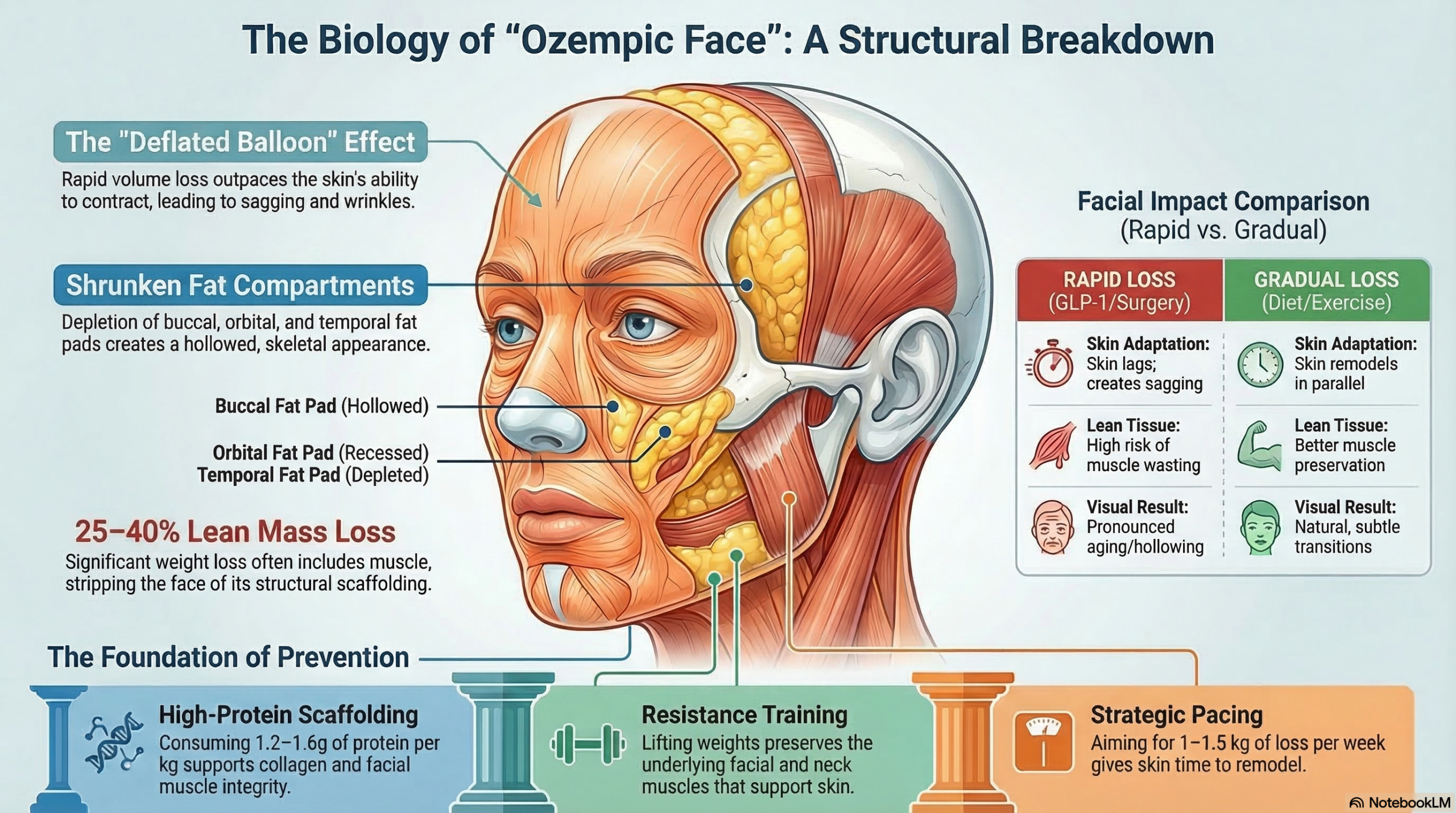
Millions of people taking GLP-1 drugs notice surprising changes in how their face looks. Here is the science behind why it happens, what it means for your health, and what you can do about it.
"Ozempic face" is the popular term for the gaunt, aged, or hollow-looking facial changes some people experience after rapid weight loss on GLP-1 drugs like semaglutide. This article explains the biology behind these changes — including the role of facial fat compartments, skin elasticity, lean mass loss, and the speed of weight loss — and what research suggests about reducing their severity.
1. What Is Ozempic Face?
"Ozempic face" is not a medical term. It is a phrase that spread on social media to describe a specific set of physical changes people noticed in themselves — or in celebrities — after losing significant weight on GLP-1 drugs like semaglutide (Ozempic, Wegovy) or tirzepatide (Mounjaro, Zepbound).
The changes people describe include a hollowed-out or sunken appearance in the cheeks and under the eyes, looser or sagging skin around the jaw and neck, a more angular or bony look to the face, and an overall appearance of looking older than before treatment — even when the body is significantly slimmer.
The term can feel alarming, but the underlying biology is not mysterious. These changes are the predictable result of rapid, significant weight loss affecting specific structures in the face — particularly fat compartments and skin. They are not unique to GLP-1 drugs. They have been documented after bariatric surgery, crash diets, and any other method that produces rapid major weight loss.
What makes GLP-1 drugs notable is scale: these medications are producing 15–20% body weight reductions in millions of people. That means the facial changes associated with major weight loss are now being observed at a population level that was previously only seen after weight loss surgery.
Ozempic face is not caused by semaglutide directly acting on the face. It is caused by rapid, significant weight loss — the same changes that would appear with any method producing similar results at similar speed. The drug creates the conditions; the biology explains the rest.
2. Why Rapid Weight Loss Changes Facial Appearance
Your face contains multiple distinct compartments of fat — not just one uniform layer. These fat compartments give your face its shape, fullness, and the smooth contours that are associated with a youthful appearance. When you lose significant weight, these fat pads shrink.
The face has several key fat compartments that are affected by weight loss:
The problem is not that these fat compartments shrink — that is expected with weight loss. The problem is speed. When weight loss happens slowly, skin has time to contract and adjust. The face adapts gradually. When weight loss happens rapidly — as it often does with GLP-1 drugs — the skin does not keep up. It is stretched over a smaller framework than it was designed for, which creates looseness, sagging, and hollow areas.
Think of it like deflating a balloon. Deflate it slowly, and it retains some shape. Deflate it quickly, and you are left with wrinkled, loose material that does not bounce back.
Dermatologists and plastic surgeons have observed these same facial changes in patients after bariatric surgery, very-low-calorie diets, and serious illness — anywhere rapid, significant weight loss occurs. The rate of fat loss, combined with the skin's limited ability to contract quickly, is the primary driver. GLP-1 drugs produce these changes at scale because they produce large, rapid weight loss at scale.
3. Fat Loss and Lean Mass Changes
Weight loss is never purely fat loss. When the body loses significant weight — through any method — it loses a mixture of fat tissue, lean tissue (muscle and other structural proteins), water, and in some cases bone density. The ratio of fat to lean tissue lost depends on how fast the weight loss occurs, how much protein is consumed, and whether resistance exercise is maintained.
This matters for facial appearance because the face is not just fat and skin. It also depends on the structural integrity of underlying muscles and connective tissue. When lean mass is lost alongside fat, the face loses some of its structural scaffolding — the toned underlying tissue that helps keep skin from sagging.
Clinical trial data on GLP-1 drugs has consistently shown that 25–40% of total weight lost may be lean mass, not fat. In practical terms, for someone losing 15 kg (33 pounds) on semaglutide, 4–6 kg of that loss may be muscle and other lean tissue. In the face, this lean mass loss compounds the fat pad depletion — both the padding and the underlying structure are reduced simultaneously.
Collagen and Structural Protein
During rapid caloric restriction, the body may break down collagen — the protein that gives skin its firmness and elasticity — as an energy source. Less collagen means skin that is thinner, less resilient, and more prone to sagging after fat loss.
Hydration and Skin Plumpness
Fat tissue retains water and contributes to the plump, hydrated appearance of skin. As facial fat shrinks and overall caloric intake drops, skin hydration can decrease. Dehydrated skin looks thinner, more wrinkled, and less elastic.
Facial Ligaments and Support
The face has a network of ligaments that anchor skin to bone. These structures support the position of fat pads. When surrounding fat and muscle shrink, these ligaments become visible as lines and folds — especially the nasolabial folds and marionette lines around the mouth.
Muscle Tone in the Face
Facial muscles give expression and contribute to the overall firmness of the face. Significant loss of lean mass — combined with reduced caloric intake — can reduce facial muscle tone, making the face appear flatter and less animated.
4. Why Some People Appear Older After Weight Loss
One of the most commonly reported and emotionally difficult aspects of Ozempic face is the perception of looking older — sometimes significantly so. This is not just subjective. Dermatologists and plastic surgeons have clinical explanations for why major weight loss accelerates visible aging in the face, while the rest of the body may look healthier and younger.
Facial Volume Is a Marker of Youth
A young face has specific volume characteristics: full cheeks, smooth contours under the eyes, defined but not skeletal jaw structure. These features are created largely by fat compartments and firm underlying tissue. As we age naturally, these fat pads slowly shrink and migrate downward. Rapid weight loss mimics decades of this aging process in a matter of months — producing changes that would normally take 10–20 years to accumulate.
Skin Elasticity Declines With Age — and Stress
Skin elasticity — its ability to snap back after being stretched — depends on collagen and elastin fibers. Young skin can adapt to moderate volume changes quickly. Older skin cannot. For people over 40 who lose major weight rapidly, the skin has both lower baseline elasticity and less time to adapt. The result is more visible sagging, deeper lines, and a more pronounced hollowing than would occur in a younger person losing the same amount of weight at the same speed.
The Body-Face Paradox
Many people experience what dermatologists informally call the "body-face paradox" — a slimmer, healthier body that looks younger, paired with a face that looks older than it did before weight loss. This is because body skin is thicker, less exposed to environmental damage, and has more redundancy to adapt. Facial skin is thinner, has been exposed to years of sun and environmental aging, and has less capacity to contract after rapid volume loss. The same weight loss affects these two areas very differently.
Nutritional Deficits Accelerate Skin Aging
During GLP-1 therapy, total food intake drops significantly. When overall nutrition is reduced, the body prioritizes vital functions over skin maintenance. Key nutrients for skin health — vitamin C (needed for collagen production), zinc (needed for skin repair), and adequate dietary protein — may all fall below optimal levels. This nutritional stress can accelerate the visible effects of fat loss on the skin's structure and appearance.
Dermatologists consistently note that Ozempic face is much more pronounced in people over 40 than in younger adults. Younger skin has greater elasticity reserves and adapts more readily to volume changes. If you are under 35 and losing weight on a GLP-1 drug, the facial aging effect is likely to be modest. If you are over 50, it can be substantial — and this is worth discussing with both your prescriber and a dermatologist before or during treatment.
5. Ozempic Face vs. Normal Weight Loss
The question many people ask is: is Ozempic face different from the facial changes that happen with any major weight loss? The answer is mostly no — but with one important qualifier: speed.
What the Face Experiences
- Fat compartments shrink faster than skin can contract
- High proportion of lean mass lost compounds effect
- Skin does not have time to gradually adapt
- Collagen breakdown may accelerate with extreme restriction
- More pronounced hollowing, sagging, and aged appearance
- Effects visible within weeks to months
What the Face Experiences
- Fat compartments shrink slowly — skin adapts in parallel
- Higher proportion of fat vs. lean mass lost
- Skin has time to gradually contract and remodel
- Nutritional intake better maintained throughout
- Facial changes less dramatic and more gradual
- Effects accumulate over months to years
The physiology of fat loss in the face is the same whether you lose weight slowly or quickly. The critical difference is whether the skin can keep pace with the shrinkage of the underlying structures. Rapid weight loss — from any cause — outpaces the skin's ability to remodel, producing more visible changes. This is why patients who have bariatric surgery often experience similar, or even more dramatic, facial changes than those on GLP-1 drugs. The drug is not special in this regard — the speed and magnitude of weight loss is.
Research on facial aging suggests that the location of fat loss matters as much as the amount. Deep facial fat compartments — particularly around the cheeks and under the eyes — are most strongly linked to the perception of youthfulness. Superficial fat loss produces less visible aging than deep compartment loss. Unfortunately, we cannot control which fat compartments the body prioritizes during weight loss — they tend to reduce proportionally with overall body fat, though genetics and individual anatomy play a role.
6. Body Composition and Appearance
Understanding Ozempic face requires thinking about the whole body — not just the face in isolation. What happens to your appearance during GLP-1 therapy is a direct reflection of your body composition: specifically, how much of your weight loss is fat versus lean tissue.
People who lose a high proportion of lean mass alongside fat tend to experience more pronounced Ozempic face. This is because they are losing both the fat padding and the underlying structural tissue simultaneously. People who protect their lean mass — through adequate protein intake and resistance training — tend to experience less severe facial changes, because the structural scaffolding under the skin remains more intact.
This is one of several reasons why body composition matters more than scale weight as a measure of how well a weight loss program is working. Two people losing 15 kg can have dramatically different outcomes for their face, their metabolism, their physical function, and their long-term health — depending entirely on how much of that loss was fat versus muscle.
- High lean mass loss = more facial hollowing, less skin support, more pronounced aging effect
- Preserved lean mass = better structural support under the skin, less sagging
- Adequate protein intake supports collagen production — the structural protein that keeps skin firm
- Resistance training maintains muscle tone in the face and neck, which helps support overlying skin
- Slower weight loss — even partial slowing — gives skin more time to adapt to changing volume
- Better nutrition during weight loss means better skin health throughout the process
It is also worth noting that some of the facial changes observed during GLP-1 therapy may be partially reversible over time. Skin has some capacity to remodel and contract after major weight loss — particularly in younger people. And for many people, the overall health improvements from significant weight loss — reduced inflammation, better blood sugar control, lower blood pressure — may have long-term positive effects on skin quality that partially offset the short-term volume loss effects.
7. Can These Changes Be Prevented?
You cannot completely eliminate the facial changes that come with significant weight loss. If you lose 20% of your body weight, your face will reflect that change. But research and clinical experience suggest that the severity of these changes can be meaningfully reduced through several evidence-informed strategies.
Prioritize Protein to Protect Collagen and Lean Mass
Collagen is a protein. Your body needs adequate dietary protein to produce and maintain it. When total protein intake falls significantly — as often happens on GLP-1 drugs due to appetite suppression — collagen production declines and skin loses structural integrity. Targeting 1.2–1.6 grams of protein per kilogram of body weight per day supports both muscle preservation and skin health. Foods rich in vitamin C (citrus, bell peppers, berries) also support collagen synthesis and should be maintained even during reduced-calorie eating.
🥩 Protein supports collagen — the skin's structural proteinDo Resistance Training to Maintain Structural Support
Resistance exercise preserves lean mass throughout the body — including the muscles of the face, neck, and jaw that support overlying skin. It also stimulates growth hormone, which plays a role in collagen synthesis and skin renewal. Adults who maintain resistance training during major weight loss consistently show better skin support and less dramatic facial aging than those who lose weight through caloric restriction alone. Two to three sessions per week is the evidence-supported minimum for meaningful lean mass preservation.
💪 Preserving lean mass preserves facial structureSlow the Rate of Weight Loss Where Possible
The faster weight is lost, the less time skin has to adapt. If you are losing weight very rapidly on a GLP-1 drug — more than 1–1.5 kg per week consistently — discussing whether dose adjustment is appropriate may be worth raising with your prescriber. This is a nuanced conversation, as faster weight loss has metabolic benefits too. But for people who are primarily concerned about facial changes, particularly older adults, slowing the pace of loss modestly can give skin more time to remodel alongside the fat loss.
⏱️ Slower loss gives skin more time to adaptStay Well Hydrated
Skin hydration directly affects its appearance and elasticity. Fat tissue holds water, and as facial fat diminishes, the skin can lose some of its natural moisture support. Drinking consistently throughout the day — not just when thirsty — helps maintain skin hydration. Topical skincare that supports the skin barrier (moisturizers containing hyaluronic acid or ceramides) can complement internal hydration by reducing water loss from the skin surface.
💧 Hydration supports skin elasticity and appearanceTalk to a Dermatologist Early — Not After the Fact
Dermatologists and cosmetic dermatologists now have significant experience managing GLP-1-related facial changes. Options like skin-tightening treatments (radiofrequency, ultrasound), dermal fillers, and targeted skincare can help address volume loss and skin laxity. These are most effective when started early — ideally while weight loss is still in progress — rather than as a correction after significant changes have occurred. If facial appearance is an important concern for you, proactive consultation before or during GLP-1 treatment is a reasonable step.
👩⚕️ Early dermatology consultation yields better outcomes8. Key Takeaways
Frequently Asked Questions
Not necessarily — but recovery varies significantly by age and how much weight was lost. Younger skin has greater elasticity and may partially rebound over time as the body adapts to the new weight. Older skin — particularly in people over 50 — has less capacity for this remodeling and the changes are more likely to persist without intervention. Some people experience partial improvement over 6–18 months as the skin gradually adjusts. Others find the changes remain stable unless addressed through dermatological treatments. The key factor is skin's inherent elasticity, which is largely determined by age and genetics.
No. Not everyone who takes GLP-1 drugs experiences noticeable facial changes. Several factors influence whether and how severely it appears: the total amount of weight lost, the speed of that loss, the person's age, their baseline skin elasticity, their genetics, how much lean mass they preserved, and their nutritional status during treatment. Younger people who lose weight gradually and maintain adequate protein intake and exercise are least likely to experience significant facial changes. Older adults who lose weight rapidly without muscle preservation strategies are at highest risk.
Partially, in some cases — but this comes with its own problems. Regaining weight can restore some facial volume, and some people who stop GLP-1 drugs and regain weight do notice their face fills in somewhat. However, research shows that weight regained after stopping GLP-1 drugs tends to be predominantly fat rather than the lean mass that was lost. This means the facial volume restoration may come with a different texture and distribution than the original fat — and the systemic health benefits of the weight loss are reversed. Weight regain is generally not a recommended strategy for addressing facial changes.
This is the "body-face paradox" that dermatologists frequently observe. The face and the rest of the body respond very differently to weight loss. Facial skin is thinner, has been exposed to more environmental aging (sun, pollution), and has less capacity to contract than the thicker skin of the abdomen or thighs. Facial fat compartments are also in specific, architecturally important locations — when they reduce, the visible effect on appearance is more immediate than equivalent fat loss from, say, the hips. The body benefits from reduced visceral fat and improved metabolic health; the face bears a disproportionate share of the visible cost of rapid volume reduction.
The type of drug matters less than the amount and speed of weight loss it produces. Tirzepatide tends to produce larger weight loss than semaglutide at standard doses — which means, on average, it may produce more pronounced facial changes. But the mechanism driving those changes is the same in both cases: rapid volume reduction in facial fat compartments outpacing skin adaptation. A person losing 10% of body weight on semaglutide would likely experience less facial change than the same person losing 20% on tirzepatide — because the total fat loss is smaller and therefore the facial compartment reduction is smaller.
For most people with significant obesity-related health conditions — including type 2 diabetes, cardiovascular disease, or high blood pressure — the health benefits of GLP-1 therapy are likely to substantially outweigh cosmetic concerns about facial appearance. However, this is a personal decision and a legitimate conversation to have with your prescriber. Some people find the facial changes distressing enough that they factor it into their treatment decision. Others find the health improvements and confidence from weight loss far outweigh the aesthetic concerns. Knowing the risk upfront — and starting protein intake and resistance training early — means you can proactively manage the outcome rather than being surprised by it.
-
1
Wilding JPH, et al. "Once-Weekly Semaglutide in Adults with Overweight or Obesity." New England Journal of Medicine. 2021;384(11):989–1002. doi.org/10.1056/NEJMoa2032183
-
2
Neeland IJ, Linge J, Birkenfeld AL. "Changes in lean body mass with GLP-1-based therapies and mitigation strategies." Diabetes, Obesity and Metabolism. 2024;26(Suppl 4):16–27. doi.org/10.1111/dom.15728
-
3
Rohrich RJ, Pessa JE. "The fat compartments of the face: anatomy and clinical implications for cosmetic surgery." Plastic and Reconstructive Surgery. 2007;119(7):2219–2227. doi.org/10.1097/01.prs.0000265403.66886.54
-
4
Cotofana S, et al. "The relationship between the deep and superficial fat compartments of the face and their clinical relevance." Journal of Anatomy. 2019;235(6):1015–1024. doi.org/10.1111/joa.13080
-
5
Look M, et al. "Body composition changes during weight reduction with tirzepatide in the SURMOUNT-1 study." Diabetes, Obesity and Metabolism. 2025;27(5):2720–2729. doi.org/10.1111/dom.16275
-
6
Tinsley GM, Nadolsky S. "Preservation of lean soft tissue during weight loss induced by GLP-1 and GLP-1/GIP receptor agonists." SAGE Open Medical Case Reports. 2025. PMC12536186