
How C10 Fatty Acids Stimulate Your Metabolism
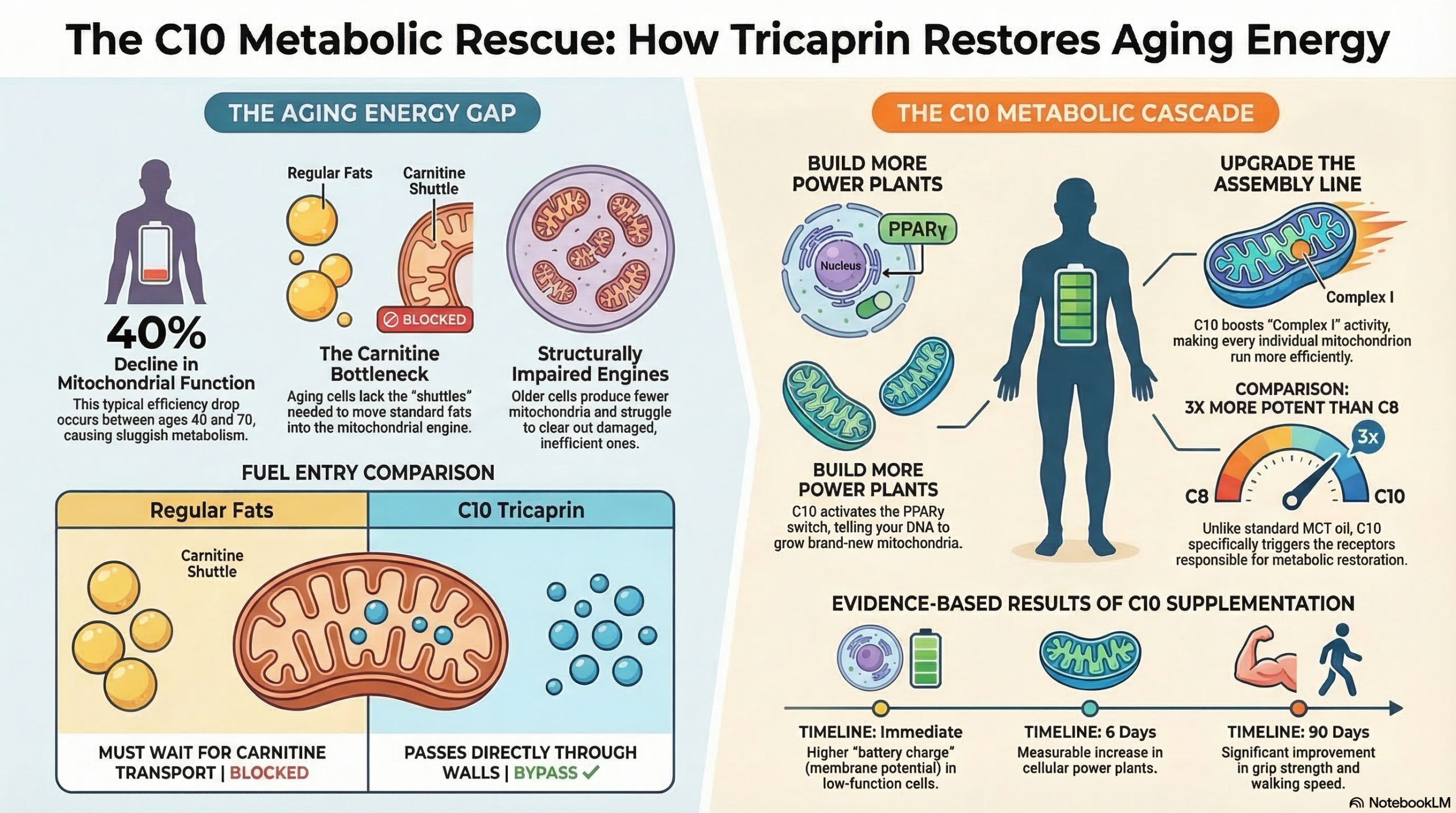
Most dietary fats take hours to become useful energy. C10 (Tricaprin) takes a different route entirely — entering your cells' power plants directly and triggering a cascade of metabolic effects no other fat can match.
Have you ever eaten a big meal and still felt like you were running on empty an hour later? Or noticed that your energy levels just aren't what they used to be — even when you're sleeping well and eating right? The reason may not be your food choices. It may be what's happening inside your cells.
As we age, the tiny energy factories inside our muscle cells — called mitochondria — become less efficient. They struggle to convert the food we eat into the energy our bodies need to move, stay warm, think clearly, and rebuild tissue. The result is a sluggish metabolism that seems to work against you no matter what you do.
This is where C10 — the fatty acid at the heart of Tricaprin — does something remarkable. It doesn't just provide calories. It directly activates the metabolic machinery inside your cells, bypasses the roadblocks that aging creates, and in doing so, helps restore the kind of cellular energy production your body had decades ago.
In this article, we'll explain exactly how that happens — in plain English, backed by peer-reviewed research.
First: What Is "Metabolism" — Really?
The word "metabolism" gets thrown around a lot, usually in the context of weight loss. But metabolism is actually much more fundamental than that. Your metabolism is the complete set of chemical reactions your body runs every second of every day to keep you alive — converting food into energy, repairing cells, moving muscles, and maintaining every organ.
The engine of all of this is the mitochondrion — a tiny structure inside almost every cell in your body. Mitochondria take fats, sugars, and proteins from the food you eat and convert them into a molecule called ATP (adenosine triphosphate) — the universal energy currency your cells actually spend.
When mitochondria work well, you have energy to spare. When they don't, everything slows down.
Why Metabolism Slows With Age
After about age 40, three things happen to mitochondria that combine to slow your metabolism significantly:
Fewer Mitochondria
Aging muscle cells produce fewer new mitochondria and clear out damaged ones less efficiently — reducing the total energy-generating capacity of your cells.
Blocked Fuel Entry
Most dietary fats need a carrier molecule called carnitine to enter the mitochondria. As we age, carnitine production falls — leaving fatty fuels stranded outside the cell's engine.
Reduced Engine Power
Even the mitochondria that remain become less efficient. The proteins that run the energy-production assembly line (called respiratory chain complexes) work at reduced capacity.
The result: your body has less fuel getting in, fewer engines to burn it, and those engines run at reduced power. This is why your metabolism is not simply "slow" — it is structurally impaired at the cellular level. And this is exactly the problem that C10 is uniquely positioned to address.
The Bypass: How C10 Gets In When Everything Else Is Locked Out
If you've read our Sarcopenia Pillar Page, you already know about the carnitine bypass. But understanding it in the context of overall metabolism makes it even more powerful.
Most dietary fats — from olive oil, meat, butter, nuts, even standard MCT oil — are long-chain or medium-long-chain fatty acids. Before they can enter a mitochondrion to be burned for energy, they must be physically carried inside by a transport molecule called carnitine. Think of carnitine as the loading dock worker who shuttles fuel barrels into the power plant.
In young, healthy cells, this system works perfectly. But in aging muscle cells — the ones most affected by sarcopenia and metabolic decline — carnitine availability drops significantly. The loading dock gets backed up. Fuel piles up outside the factory door. The engine, starved of its supply, slows to a crawl.
C10's 10-carbon chain is short enough to diffuse directly through the mitochondrial membrane — arriving instantly at the site of energy production, regardless of carnitine status.
C10 (decanoic acid) has just 10 carbon atoms in its chain — short enough to pass directly through the mitochondrial wall by passive diffusion, without waiting for carnitine at all. It skips the queue entirely. In a cell where the normal fuel supply is throttled, C10 arrives at the engine fully loaded and ready to burn.
The carnitine bypass is not only relevant to skeletal muscle. Your heart muscle, brain cells, and liver all rely on mitochondrial fatty acid oxidation — and all are affected by age-related declines in carnitine transport. C10's ability to enter mitochondria directly makes it a whole-body metabolic fuel, not just a muscle-specific intervention.
Beyond the Bypass: Three Ways C10 Directly Stimulates Your Metabolism
The carnitine bypass gets C10 into the mitochondrion. But what happens next is where the real metabolic story gets interesting. Once inside the cell, C10 does three things that no other dietary fat has been shown to do simultaneously.
Effect 1: It Activates PPARγ — The "Build More Factories" Switch
Inside your cell nucleus, there is a master control protein called PPARγ (Peroxisome Proliferator-Activated Receptor gamma). When activated, PPARγ acts like a construction foreman — it reads specific sections of your DNA and switches on the genes responsible for building new mitochondria. This process is called mitochondrial biogenesis.
C10 is a confirmed PPARγ agonist — meaning it binds to and activates this receptor. In a landmark 2014 study published in the Journal of Neurochemistry, researchers at University College London demonstrated that C10 — but not C8 — caused a measurable increase in mitochondrial content in neuronal cells over just six days, and that this effect was blocked when PPARγ was inhibited. In other words: C10 tells your cells to build more power plants.
For aging adults with declining mitochondrial numbers, this is significant. You are not just getting more fuel into existing mitochondria — you are triggering the cellular machinery to make more mitochondria in the first place.
Effect 2: It Upgrades the Assembly Line — Complex I Activation
Inside every mitochondrion, energy is produced through a series of protein machines called the respiratory chain complexes (numbered I through V). Think of them as an assembly line: each one passes electrons along the chain, and the energy released by this movement is captured to produce ATP. Complex I is the first and most important step — often called the "rate-limiting" machine of the whole process.
The same UCL research group found that C10 treatment significantly increased Complex I activity in mitochondria. More importantly, the ratio of Complex I activity to total mitochondrial content also rose — meaning each individual mitochondrion was running more efficiently, not just that there were more of them. A later study confirmed C10 also elevated activity at Complex I+III and Complex IV — amplifying power output across the entire respiratory chain.
In practical terms: C10 doesn't just get fuel into the factory. It speeds up the assembly line inside the factory.
Effect 3: It Activates SIRT1 — The Longevity Enzyme
The third metabolic effect of C10 connects to one of the most exciting areas of longevity science. Sirtuins are a family of proteins — sometimes called "longevity enzymes" — that regulate energy metabolism, DNA repair, and stress responses. SIRT1 in particular is strongly associated with improved metabolic efficiency, reduced inflammation, and extended healthspan in aging organisms.
A 2020 study published in Nutrients found that C10 incubation significantly elevated SIRT1 enzyme activity in hippocampal neurons, alongside the upregulation of the mitochondrial respiratory chain. The researchers concluded that this SIRT1 activation — achieved post-translationally, meaning through direct protein modification rather than gene expression changes — may be one of the key mechanisms underlying C10's metabolic benefits in aging cells.
Sirtuins are activated by caloric restriction and fasting — both powerful but difficult interventions. C10 may offer a more accessible path to the same metabolic signaling.
The Research Behind These Effects
Four peer-reviewed studies underpin the metabolic mechanisms described in this article.
C10 Increases Mitochondrial Number via PPARγ
Hughes et al. (2014) in Journal of Neurochemistry demonstrated that C10 — not C8 — caused a marked increase in citrate synthase (a mitochondrial content marker) and Complex I activity in neuronal cells after just 6 days. A PPARγ antagonist blocked these effects, confirming the receptor pathway. Electron microscopy confirmed increased mitochondrial number.
Read the Study → Journal of Neurochemistry, 2014C10 Upregulates Respiratory Chain Complexes & SIRT1
Viswanath et al. (2020) in Nutrients found C10 incubation in hippocampal neurons significantly elevated Complex I+III and Complex IV activity, along with SIRT1 enzyme activity — without changing citrate synthase, suggesting the effect was about making each mitochondrion more efficient, not just more numerous.
Read the Study → Nutrients, 2020C10-Containing MCTs Improve Human Metabolic Outcomes
The human clinical evidence for these mitochondrial mechanisms translating into real-world metabolic benefit comes from the Frontiers in Nutrition (2023) sarcopenia trial: 6g/day of C8/C10 MCTs produced significant improvements in grip strength, walking speed, and muscle mass in frail older adults over 3 months — consistent with the cellular energy restoration effects described above.
Read the Study → Frontiers in Nutrition, 2023C10 Optimises Mitochondrial Membrane Potential
UCL Discovery research (Kanabus, 2018) found C10 raised mitochondrial membrane potential in cells — a direct measure of how much "charge" the mitochondrial battery holds. Higher membrane potential means greater ATP-generating capacity. Critically, this effect appeared to normalise mitochondrial function — increasing it in low-function cells while not over-driving high-function ones.
Read the Research → UCL Discovery, 2018Putting It All Together: What C10 Actually Does to Your Metabolism
Let's step back and look at the full picture. When you consume C10 Tricaprin, here is what the research suggests is happening inside your cells — simultaneously:
1. Immediate fuel delivery: C10 bypasses the carnitine bottleneck and enters mitochondria directly — delivering energy to cells that were effectively starving.
2. Factory expansion: C10 activates PPARγ, triggering the production of new mitochondria — increasing the total energy-generating capacity of aging cells.
3. Assembly line upgrade: C10 boosts Complex I and Complex IV activity — making each mitochondrion run more efficiently, producing more ATP per unit of fuel.
4. Longevity signaling: C10 activates SIRT1 — a key longevity and metabolic regulator that improves energy efficiency and stress resilience in aging cells.
5. Anti-catabolic protection: When cells have adequate energy, they stop breaking down muscle tissue for fuel — halting the cycle of muscle loss that drives sarcopenia.
This is not a single trick. It is a coordinated metabolic rescue — addressing the root causes of cellular energy failure in aging, rather than just masking the symptoms.
Why C10 and Not C8?
This question deserves a direct answer, because most "MCT oil" products are heavily weighted toward C8 (caprylic acid). C8 converts rapidly to ketones in the liver and is an excellent brain fuel — particularly for people following ketogenic diets or managing cognitive decline. But the specific metabolic effects described in this article — PPARγ activation, mitochondrial biogenesis, Complex I upregulation, SIRT1 activation, GLP-1 secretion — have been demonstrated for C10 specifically, and not replicated by C8 in the same studies. If your goal is metabolic restoration in aging muscle, C10 is the right molecule.
Practical Guide: Using C10 to Support Your Metabolism
Choose Pure C10 — Read the Label
Look for "Capric Acid (C10:0)" or "Glycerol Tricaprate" as the primary ingredient. Avoid products that only say "MCT oil" without specifying percentages — the majority are 60–80% C8. The PPARγ, Complex I, and SIRT1 research was conducted specifically on C10, not C8-dominant blends.
Start at 1 Teaspoon Per Day, Build Slowly
Begin with ~5g (1 tsp) per day mixed into morning coffee, a smoothie, or drizzled on food. The mitochondrial effects in research took 6 days to appear at the cellular level — consistency matters more than dose in the early weeks. Increase to 1–1.5 tablespoons over 2–4 weeks as your gut adjusts.
Take It With Your First Meal of the Day
For metabolic support specifically, morning use has the most research backing. Taking C10 at breakfast — when cells are transitioning from overnight fasting — may maximize the mitochondrial fuel signal and set a positive metabolic tone for the whole day.
Pair With Light Movement — Even a 15-Minute Walk
Exercise is the most powerful mitochondrial biogenesis trigger known. C10's PPARγ activation and exercise's AMPK activation work through parallel pathways — combining them creates a synergistic effect. You don't need to train hard; a brisk 15-minute walk after your C10-containing breakfast is enough to amplify the mitochondrial signal.
Commit to 90 Days and Track Your Energy
Mitochondrial biogenesis is a slow, structural process. The muscle research ran for 3 months. Track a simple daily energy score (1–10) at the same time each day — mid-afternoon is ideal, as this is when metabolic fatigue is most noticeable. Look for a gradual upward trend over weeks 4–12, not overnight results.
-
1
C10, PPARγ & Mitochondrial Biogenesis — Hughes SD, Kanabus M, Anderson G, et al. "The ketogenic diet component decanoic acid increases mitochondrial citrate synthase and complex I activity in neuronal cells." Journal of Neurochemistry. 2014;129(3):426–433.
DOI: https://doi.org/10.1111/jnc.12646 -
2
C10, Respiratory Chain Complexes & SIRT1 — Viswanath V, et al. "Mechanism of Action of Ketogenic Diet Treatment: Impact of Decanoic Acid and Beta-Hydroxybutyrate on Sirtuins and Energy Metabolism in Hippocampal Murine Neurons." Nutrients. 2020;12(8):2379.
DOI: https://doi.org/10.3390/nu12082379 -
3
C10 Mitochondrial Membrane Potential & Biogenesis (UCL) — Kanabus M. "Metabolic consequences of cellular exposure to decanoic acid." UCL Discovery. 2018.
URL: https://discovery.ucl.ac.uk/id/eprint/10053453/ -
4
Human MCT Muscle Trial — Ezaki O, Abe S. "Medium-chain triglycerides (8:0 and 10:0) increase muscle mass and function in frail older adults: a combined data analysis of clinical trials." Frontiers in Nutrition. 2023;10:1284497.
DOI: https://doi.org/10.3389/fnut.2023.1284497